
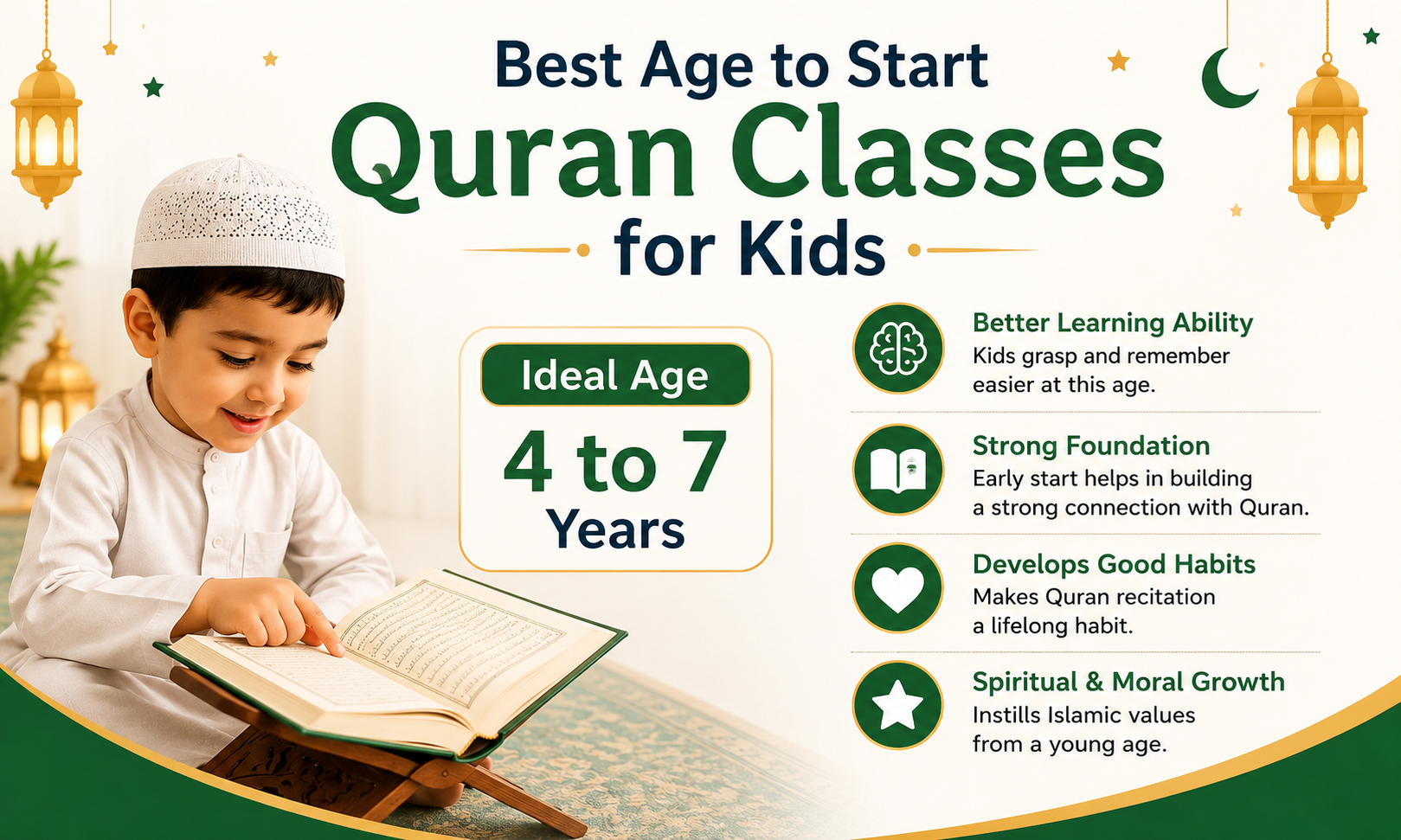
Best Age to Start Quran Classes for Kids: A Complete Guide for Parents
Introduction
Every Muslim parent dreams of raising children who love the Holy Quran and follow the teachings of Islam. One of the most common questions parents ask is, “What is the best age to start Quran classes for kids?”
There is no single age that fits every child because each child develops differently. However, Islamic scholars and child education experts agree that introducing children to the Quran at an early age helps build a lifelong connection with Allah (SWT) and His Book.
At Al Mehdi Quran Center, we have taught hundreds of children from different countries through our online Shia Quran classes. Based on our experience, children can begin learning the Quran in a structured and enjoyable way as early as 4 to 6 years old, depending on their readiness.
In this guide, we will discuss the ideal age to start Quran learning, signs that your child is ready, the benefits of early Quran education, and how parents can create a positive learning environment at home.
Quran and Ahlulbayt (A.S.) on Early Islamic Education
Islam places great importance on educating children from an early age. The Holy Quran instructs parents to nurture their families in faith and worship. Allah (SWT) says:
“And enjoin prayer upon your family and be steadfast therein.” (Quran 20:132)
The Quran also reminds believers:
“O you who believe! Protect yourselves and your families from the Fire.” (Quran 66:6)
The teachings of the Ahlulbayt (A.S.) beautifully complement these Quranic principles. Imam Ali (A.S.) said:
“The heart of a young child is like uncultivated land; whatever is planted in it, it accepts.” (Nahj al-Balagha, Letter 31)
This highlights why parents should begin nurturing Islamic values while children are still young.
Imam Ja’far al-Sadiq (A.S.) also outlined the stages of child development, saying:
“Let your child play for seven years, educate and discipline him for seven years, and keep him close to you for the following seven years.” (Al-Kafi)
This famous narration shows that the years between childhood and adolescence are the ideal period for structured learning, including Quran recitation, Tajweed, Islamic manners, and love for the Ahlulbayt (A.S.).
Based on these teachings, many Muslim parents begin introducing the Quran around the ages of four to six, while more structured education naturally develops during the first seven years and continues throughout childhood.
Why Early Quran Education Matters
Childhood is the foundation of a person’s character and beliefs. During these early years, children learn quickly, memorize easily, and develop habits that often stay with them for life.
Starting Quran education early helps children:
- Build love for Allah (SWT)
- Develop respect for Islamic values
- Learn proper manners (Akhlaq)
- Improve pronunciation through Tajweed
- Memorize Surahs more easily
- Strengthen their Islamic identity
- Create a daily habit of Quran recitation
Children who begin learning the Quran at a young age often feel more comfortable with Arabic pronunciation and retain what they learn for many years.
What Is the Best Age to Start Quran Classes?
Although every child is unique, the following age groups provide a helpful guideline.
Ages 2–4: Introduction Stage
Children at this age are naturally curious. While they are usually too young for formal Quran lessons, they can still become familiar with the Quran.
Parents can:
- Play Quran recitation at home.
- Teach short Islamic duas.
- Introduce “Bismillah.”
- Tell stories of the Prophets.
- Encourage listening to beautiful Quran recitation.
The goal is simply to create love for the Qura
Ages 4–6: The Ideal Starting Age
Most Islamic educators consider 4 to 6 years the ideal age for beginning structured Quran classes.
Children at this age can:
- Recognize Arabic letters
- Follow simple instructions
- Sit attentively for short lessons
- Begin Noorani Qaida
- Learn correct pronunciation
- Memorize short Surahs
This stage forms the strongest foundation for future Quran learning.
Ages 7–10: Strong Learning Phase
By this age, children have improved concentration and memory.
They can begin:
- Quran reading with Tajweed
- Daily Quran practice
- Memorization (Hifz)
- Understanding basic Quran meanings
- Learning Islamic etiquette
Parents who begin Quran classes during this age still see excellent results.
Is It Ever Too Late?
Absolutely not.
Many children start Quran classes after the age of 10 and become excellent Quran readers. Adults also begin Quran learning every year.
The best time to start is simply as soon as your child is ready.
Signs Your Child Is Ready for Quran Classes
Instead of focusing only on age, parents should also observe readiness.
Your child may be ready if they can:
- Sit for 20–30 minutes
- Listen carefully
- Repeat words correctly
- Recognize letters and sounds
- Follow teacher instructions
- Enjoy learning activities
- Show interest in Islamic stories
If your child demonstrates most of these abilities, they are likely prepared for structured Quran learning.
Benefits of Starting Quran Classes Early
1. Easier Memorization
Young children have exceptional memory. They can memorize short Surahs much faster than older learners.
Early memorization also improves long-term retention.
2. Better Arabic Pronunciation
Children naturally imitate sounds.
Learning Arabic pronunciation early helps them develop proper Makharij and Tajweed without forming incorrect habits.
3. Strong Islamic Identity
Early Quran education teaches children:
- Respect
- Honesty
- Kindness
- Patience
- Responsibility
These values shape their personalities throughout life.
4. Love for Worship
Children who regularly read the Quran often become more interested in:
- Salah
- Duas
- Islamic celebrations
- Masjid activities
- Family worship
Quran learning becomes part of their daily routine.
5. Better Discipline
Regular Quran classes teach children:
- Time management
- Listening skills
- Respect for teachers
- Focus
- Consistency
These skills also help them perform better in school.
Why Parents Choose Al Mehdi Quran Center
At Al Mehdi Quran Center, we understand that every child learns differently.
Our online Quran classes are designed to make learning enjoyable, interactive, and spiritually rewarding.
We provide:
- Qualified Shia Quran teachers
- One-on-one live classes
- Flexible class timings
- Personalized learning plans
- Quran with Tajweed
- Quran memorization support
- Quran Tafseer lessons
- Islamic Studies based on Fiqh-e-Jafariya
Our teachers use positive encouragement rather than pressure, helping children build confidence while learning the Holy Quran.
Tips for Parents Starting Quran Classes
Parents play an essential role in their child’s Quran journey.
Here are some practical tips.
Create a Daily Routine
Set aside a fixed time each day for Quran learning.
Consistency produces better results than long but irregular lessons.
Encourage Without Pressure
Children enjoy learning when they receive praise and encouragement.
Avoid comparing your child with others.
Every learner progresses differently.
Practice at Home
Spend 10–15 minutes reviewing what your child learned during class.
Regular revision greatly improves progress.
Make Learning Fun
Use:
- Islamic storybooks
- Quran flashcards
- Educational games
- Reward charts
A positive environment keeps children motivated.
Lead by Example
Children imitate their parents.
When parents read the Quran regularly, children naturally develop interest in doing the same.
Common Mistakes Parents Should Avoid
Many parents unintentionally make Quran learning difficult.
Avoid these common mistakes.
Starting Too Late
Waiting until teenage years often makes learning more challenging.
Expecting Fast Results
Quran learning requires patience and consistency.
Progress happens gradually.
Skipping Practice
Weekly lessons alone are not enough.
Daily revision is essential.
Forcing Long Lessons
Young children have shorter attention spans.
Short, engaging lessons are usually more effective.
Choosing Teachers Without Experience
Children need teachers who understand both Quran education and child psychology.
Experienced teachers know how to keep lessons interesting and productive.
Why Learning According to Shia Teachings Is Important
For Shia families, learning the Quran alongside the teachings of Ahlulbayt (A.S.) provides a complete Islamic education.
Children not only learn correct recitation but also gain an understanding of:
- Love of Prophet Muhammad (PBUH & His Holy Progeny)
- The virtues of Imam Ali (A.S.)
- Respect for the Ahlulbayt (A.S.)
- Islamic morals
- Authentic duas
- Fiqh-e-Jafariya principles
This balanced approach strengthens both knowledge and faith.
Frequently Asked Questions
Can a 4-year-old learn the Quran?
Yes. Many children begin learning Arabic letters and Noorani Qaida at four years old if they are emotionally and mentally ready.
Should children memorize or first learn reading?
Most teachers recommend learning proper reading first before beginning Hifz.
A strong foundation leads to better memorization.
How long should Quran classes be?
For young children, 25–35 minutes is usually ideal.
Older children can gradually increase lesson duration.
How many classes per week are recommended?
Most families choose three to five classes each week, combined with daily home practice.
Can children learn Quran online effectively?
Yes.
With qualified teachers, one-on-one instruction, and parental support, online Quran classes are highly effective and convenient.
Final Thoughts
The best age to start Quran classes for kids is not simply about reaching a certain birthday—it is about recognizing when your child is ready to learn. For many children, the ideal time is between 4 and 6 years old, when they are curious, eager to learn, and able to follow simple instructions.
Beginning Quran education early gives children a strong spiritual foundation, improves their Arabic pronunciation, strengthens their Islamic identity, and nurtures a lifelong love for the Holy Quran. Even if your child is older, it is never too late to begin. The most important step is to start with patience, consistency, and the guidance of qualified teachers.
At Al Mehdi Quran Center, we are committed to helping children learn the Holy Quran according to authentic Shia (Fiqh-e-Jafariya) teachings through engaging one-on-one online classes. Our experienced teachers create a supportive learning environment where children can develop confidence, improve their recitation, and grow in their understanding of Islam.
If you are looking for a trusted place to begin your child’s Quran journey, we invite you to join our online classes and experience a personalized approach to Quran education.
Start Your Child’s Quran Journey Today
Book a FREE trial class with Al Mehdi Quran Center and help your child build a lifelong connection with the Holy Quran through authentic Shia teachings.