
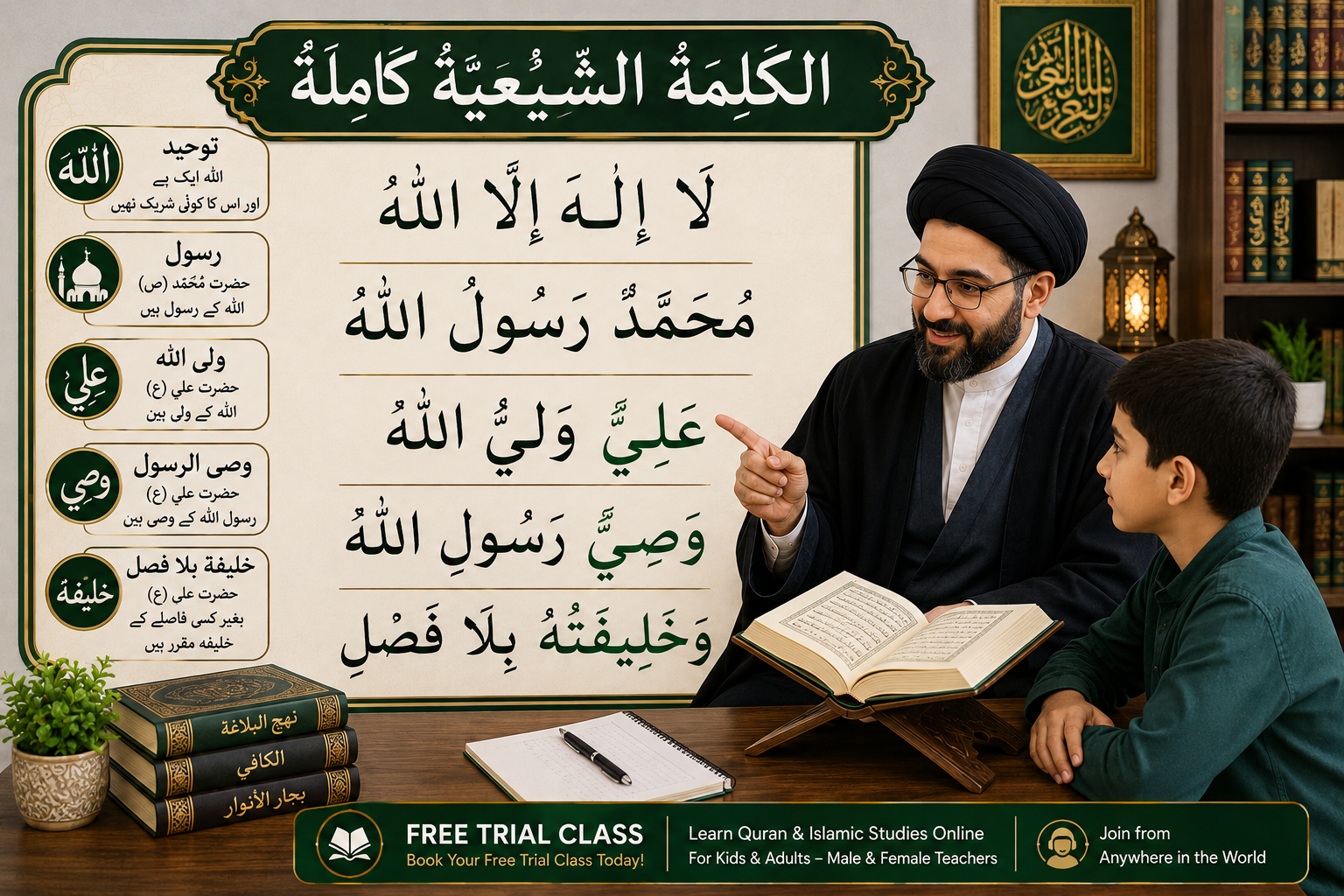
Shia Kalma and the Teachings of Ahlulbayt (A.S.): A Complete Guide
The Shia Kalma is an important expression of Islamic faith that reflects belief in the Oneness of Allah, the Prophethood of Muhammad (S.A.W.), and, from the Shia perspective, the importance of the Wilayah of Imam Ali (A.S.) and the Ahlulbayt (A.S.).
For Muslim families who want to teach their children about their faith, learning the Kalma is one of the basic steps in Islamic education. However, memorizing the words alone is not enough. Students should also understand their meaning and learn how the teachings of the Ahlulbayt (A.S.) help Muslims understand and live according to the message of Islam.
This Shia Kalma Guide explains the meaning of the Kalma, its connection with Tawheed and Prophethood, the significance of Imam Ali (A.S.), and the role of the Ahlulbayt (A.S.) in Islamic learning.
What Is the Shia Kalma?
The word Kalma is commonly used by Muslims to refer to the declaration of faith, also known as the Shahada.
The core declaration of Islamic faith is:
Ashhadu an la ilaha illallah, wa ashhadu anna Muhammadan rasulullah.
Its meaning is:
“I bear witness that there is no god but Allah, and I bear witness that Muhammad is the Messenger of Allah.”
This declaration establishes two fundamental beliefs: Tawheed, the Oneness of Allah, and the Prophethood of Muhammad (S.A.W.). A scholarly explanation published by Al-Islam.org identifies the shortest form of the Shahada as belief in the Oneness of God and acceptance of Muhammad as His Prophet.
In Shia Islamic tradition, the belief in the Wilayah and Imamat of Imam Ali (A.S.) is also central to understanding the faith.
What Does “Aliyyun Waliullah” Mean?
One phrase commonly associated with Shia belief is:
Ashhadu anna Aliyyan Waliyyullah.
It can be translated as:
“I bear witness that Ali is the Wali of Allah.”
The phrase expresses the Shia belief in the special spiritual authority and Wilayah of Imam Ali ibn Abi Talib (A.S.).
The word Wali has meanings including guardian, friend, protector, or one who possesses authority, depending on context. In Shia theology, Wilayah is closely connected with the belief in the divinely appointed guidance of the Imams from the Ahlulbayt (A.S.).
It is important to make a distinction here. “Aliyyun Waliullah” is not considered a required component of the Shahada for a person to become Muslim. A scholarly response on Al-Islam.org explains that testimony to Allah’s Oneness and Muhammad’s Prophethood is sufficient for entering Islam, while testimony to the Wilayah of Imam Ali (A.S.) is not an essential requirement for conversion.
Shia Kalma and the Ahlulbayt (A.S.)
The Ahlulbayt (A.S.) hold a central position in Shia Islam. They are the family of the Prophet Muhammad (S.A.W.), and Shia Muslims look to their teachings for guidance in understanding and practicing Islam.
The Ahlulbayt (A.S.) include:
- Prophet Muhammad (S.A.W.)
- Lady Fatima Zahra (S.A.)
- Imam Ali (A.S.)
- Imam Hasan (A.S.)
- Imam Husain (A.S.)
- And the nine Imams from the descendants of Imam Husain (A.S.)
The teachings of the Ahlulbayt (A.S.) emphasize Tawheed, justice, worship, good character, knowledge, compassion, patience, and obedience to Allah.
Therefore, teaching the Shia Kalma to children and adults can be an opportunity not only to memorize a declaration but also to introduce students to the beliefs and values represented by the Ahlulbayt (A.S.).
The First Part: Belief in One Allah
The first foundation of the Kalma is:
La ilaha illallah
Meaning:
“There is no god but Allah.”
This statement represents Tawheed, the belief that Allah is One and has no partner.
The Quran repeatedly teaches Muslims about the Oneness of Allah. Understanding Tawheed helps students recognize that worship belongs to Allah alone.
For children, this concept can be explained in simple language. They can learn that Allah created the universe, gives us blessings, hears our prayers, and guides us toward what is good.
For adults, the study of Tawheed can go deeper into subjects such as Allah’s attributes, worship, reliance upon Allah, and the relationship between faith and daily life.
The Second Part: Prophet Muhammad (S.A.W.)
The second fundamental declaration is:
Muhammadur Rasulullah
Meaning:
“Muhammad is the Messenger of Allah.”
Belief in Prophet Muhammad (S.A.W.) means accepting his Prophethood and respecting his teachings.
The Prophet Muhammad (S.A.W.) taught people how to worship Allah, develop good character, establish justice, care for others, and live according to divine guidance.
For Shia Muslims, the Prophet’s relationship with the Ahlulbayt (A.S.) is particularly important. Studying the Prophet’s life together with the teachings of his family can help students understand the broader Shia approach to Islamic guidance.
The Importance of Imam Ali (A.S.)
Imam Ali ibn Abi Talib (A.S.) occupies a central position in Shia Islamic belief.
He was the cousin and son-in-law of Prophet Muhammad (S.A.W.), the first Imam according to Shia belief, and a prominent figure in Islamic history.
Shia Muslims believe that Imam Ali (A.S.) was appointed as the successor and spiritual leader after the Prophet Muhammad (S.A.W.).
The concept of Wilayah therefore has an important place in Shia theology.
Learning about Imam Ali (A.S.) should not be limited to memorizing his name. Students can also study his justice, courage, knowledge, humility, worship, generosity, and concern for the rights of others.
His famous sermons, letters, and sayings collected in Nahjul Balagha provide valuable lessons about faith, ethics, leadership, justice, and human responsibility.
The Connection Between Kalma and Ahlulbayt (A.S.)
The Kalma begins with Tawheed and Prophethood. Shia Islamic teaching then emphasizes following the guidance of the Ahlulbayt (A.S.).
This connection can be understood as a journey of faith:
Allah → Prophet Muhammad (S.A.W.) → Ahlulbayt (A.S.)
The purpose is not to worship the Ahlulbayt (A.S.). Worship belongs to Allah alone. Rather, Shia Muslims believe that the Ahlulbayt (A.S.) provide guidance toward understanding and practicing the religion brought by the Prophet Muhammad (S.A.W.).
This distinction is especially important when teaching children. Students should understand that Allah is the Creator and the only One worthy of worship, while the Prophet and Ahlulbayt (A.S.) are divinely guided servants and leaders whose teachings guide believers toward Allah.
Why Should Children Learn the Shia Kalma?
Children begin developing their religious understanding from an early age. Learning the Kalma can give them a foundation for understanding their Muslim identity and beliefs.
However, children should learn both words and meanings.
A teacher can explain:
- Who Allah is
- What Tawheed means
- Who Prophet Muhammad (S.A.W.) is
- Who Imam Ali (A.S.) is
- Who the Ahlulbayt (A.S.) are
- Why Muslims follow the Quran
- Why good character is important
- How Islamic beliefs affect everyday behavior
Using simple examples can make these lessons easier for children to understand.
Shia Kalma Learning for Adults
Adults may already know the Kalma but want to understand its deeper meaning.
A structured Shia Kalma Course or Islamic studies class can explore:
- Tawheed
- Prophethood
- Imamat
- Wilayah
- Ahlulbayt (A.S.)
- Quranic guidance
- Islamic ethics
- The life of Imam Ali (A.S.)
- The importance of following authentic Islamic teachings
Adults can also ask questions and discuss subjects that may not have been explained during childhood.
Is “Aliyyun Waliullah” Part of Adhan?
This is an important question because the phrase is commonly heard in Shia communities.
According to Shia sources, “Ashhadu anna Aliyyan Waliullah” is not a wajib or essential part of the Adhan. It may be recited as a recommended or optional statement, but it should not be treated as a required component of the formal Adhan. Al-Islam.org’s discussion of the form of Adhan describes the phrase as recommended by Imami scholars, rather than an essential element.
This distinction helps avoid confusion when teaching students about the Shia Kalma, Shahada, and Adhan.
Shia Kalma and Islamic Character
The Kalma should influence a Muslim’s behavior.
If a person believes in Allah, that belief should encourage honesty, humility, patience, kindness, and responsibility.
The teachings associated with Imam Ali (A.S.) strongly emphasize justice, compassion, knowledge, and accountability.
Therefore, learning the Kalma should be connected with practical Islamic education.
A child who learns “La ilaha illallah” can also learn to depend upon Allah.
A student who learns “Muhammadur Rasulullah” can learn about the Prophet’s character.
A student who learns about Imam Ali (A.S.) can learn about justice, courage, knowledge, and service to others.
In this way, the Kalma becomes more than a memorized sentence. It becomes a foundation for faith and character.
How Online Shia Quran Classes Can Help
Online Quran education provides an accessible way for Muslim families to teach children and adults from home.
At Al-Mehdi Quran Center, students can learn Quran and Islamic Studies through online classes designed for different ages and learning levels.
Online learning can provide:
- One-on-one classes
- Qualified Quran teachers
- Shia Islamic learning
- Flexible class schedules
- Classes for children and adults
- Quran reading and Tajweed
- Quran Tafseer
- Islamic Studies
- Personalized learning
- Online access from different countries
A student can begin with basic Islamic beliefs and gradually progress toward more detailed Quran and Ahlulbayt (A.S.) studies.
Frequently Asked Questions About Shia Kalma
What is the Shia Kalma?
The Shia Kalma refers to the declaration of Islamic faith centered on belief in the Oneness of Allah and the Prophethood of Muhammad (S.A.W.), with Shia Muslims also emphasizing the Wilayah and Imamat of Imam Ali (A.S.) and the Ahlulbayt (A.S.).
What does “Aliyyun Waliullah” mean?
“Ashhadu anna Aliyyan Waliullah” means, “I bear witness that Ali is the Wali of Allah.” It expresses the Shia belief in the Wilayah of Imam Ali (A.S.).
Is Aliyyun Waliullah required to become Muslim?
No. According to the scholarly explanation cited by Al-Islam.org, belief in Allah’s Oneness and Muhammad’s Prophethood is sufficient for entering Islam. “Aliyyun Waliullah” is not an essential requirement for conversion.
Can children learn the Shia Kalma online?
Yes. Children can learn the Kalma, its meaning, and basic Shia Islamic beliefs through age-appropriate online lessons.
Can adults study Shia Islamic beliefs online?
Yes. Adults can study the Kalma, Tawheed, Prophethood, Imamat, Wilayah, and the teachings of the Ahlulbayt (A.S.) through structured online Islamic education.
Does Al-Mehdi Quran Center offer a Free Trial Class?
Yes. New students may be able to join a Free Trial Class, subject to teacher availability and scheduling.
Conclusion
The Shia Kalma is an important foundation for understanding Islamic faith. Its core message begins with belief in the Oneness of Allah and the Prophethood of Muhammad (S.A.W.). For Shia Muslims, understanding the faith also involves learning about the Wilayah and Imamat of Imam Ali (A.S.) and the guidance of the Ahlulbayt (A.S.).
The most beneficial way to teach the Kalma is not simply to memorize its words but to understand its meaning and apply its values in daily life.
Children can develop a strong foundation of Islamic belief through age-appropriate lessons, while adults can explore the theological and spiritual meanings in greater depth.
Through structured Shia Quran and Islamic Studies classes, students can learn about the Quran, the Prophet Muhammad (S.A.W.), Imam Ali (A.S.), and the Ahlulbayt (A.S.) in a respectful and educational environment.
If you are looking for Shia Quran classes for kids and adults, online learning can provide a convenient way to study from home with qualified teachers.
Start Learning Shia Quran and Islamic Studies Online
Would you like to learn the Shia Kalma, Quran, and the teachings of Ahlulbayt (A.S.) with proper guidance?
At Al-Mehdi Quran Center, we offer personalized online Quran and Islamic Studies classes for kids and adults. Students can learn Quran reading, Tajweed, Tafseer, Shia Islamic Studies, and the teachings of Ahlulbayt (A.S.) from qualified teachers.
Book Your Free Trial Class
Take the first step toward learning the Quran and understanding your faith.
Join a Free Trial Class Today and experience personalized online Quran learning from the comfort of your home.
Suitable for: Kids | Adults | Beginners | Sisters | Families
Learn Quran. Understand Quran. Live Quran.